Military AI Escalation: Autonomy Compresses Decision Time — Governance Does Not
NYT April 12 feature on U.S., China, Russia accelerating AI-backed autonomous weapons and defense — China’s Sept 2025 parade AI drones cited; nuclear-age analogy from experts. Capability demos are outrunning verifiable arms-control regimes; parade footage is reporting, not order-of-battle proof.

Corrected October 14, 2026: Rewrote the China, U.S. and Russia rows to match the New York Times report (read via the Indian Express syndicated copy), and removed unsupported references to Anthropic's Mythos Preview and lab cyber warnings from the summary and opening.
The non-obvious frame is tempo: AI that identifies, decides, and acts without continuous human input shrinks the escalation ladder faster than treaties can define “meaningful human control.” Parade footage is a symptom, not the full arsenal map.
The New York Times (April 12) reported accelerated development of AI-backed autonomous weapons and defense systems by China, the U.S., Russia, and others — capabilities that reduce need for human intervention in combat decisions. Piece invokes nuclear-age comparisons from experts. CSET’s Emelia Probasco is quoted in the piece.
Reported developments#
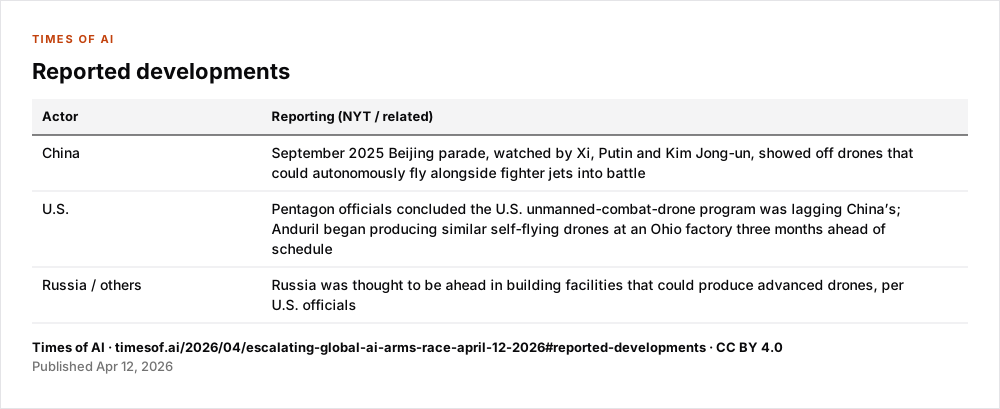
| Actor | Reporting (NYT / related) |
|---|---|
| China | September 2025 Beijing parade, watched by Xi, Putin and Kim Jong-un, showed off drones that could autonomously fly alongside fighter jets into battle |
| U.S. | Pentagon officials concluded the U.S. unmanned-combat-drone program was lagging China’s; Anduril began producing similar self-flying drones at an Ohio factory three months ahead of schedule |
| Russia / others | Russia was thought to be ahead in building facilities that could produce advanced drones, per U.S. officials |
Systems can compress detect→decide→act loops dramatically — journalistic synthesis, not a declassified CONOPS.
Claims vs checks#
Narrative and parade specifics are from The New York Times' reporting. Order-of-battle readiness, autonomy levels (LOA), and accidental-conflict probabilities have not been independently verified.
Limits#
- Open-source military reporting is incomplete by design.
- “Nuclear analogy” is rhetorical/expert framing, not a legal equivalence.
- CSET analyses are secondary cross-checks, not primary intel.
Sources#
- The New York Times: “Mutually Automated Destruction: The Escalating Global A.I. Arms Race” (April 12, 2026).
- The Indian Express (syndicating The New York Times): Mutually automated destruction: The escalating global AI arms race
- CSET: note on Emelia Probasco’s comments in the NYT article (April 12, 2026)