Nvidia-Led Open-Weights Letter: Coalition Fight—OpenAI, Anthropic, Google Absent
Nvidia, Microsoft, Meta and ~25 firms urged Washington to avoid premature restrictions on open-weight models and sweeping distillation bans—Huang’s first X post. OpenAI, Anthropic, and Google did not sign. Lands as the White House weighs Chinese open-model limits.

Corrected October 14, 2026: Corrected the timing of the House kill-switch bill relative to the letter, and replaced general context with the Lieu–Moran bill's DHS graduated emergency powers; corrected an internal link.
Open-weight policy is now a coalition fight, not a fringe OSS debate. Chip vendors, hyperscalers with open-model stakes, and enterprise software names are lobbying for a plural frontier—while frontier closed labs stay off the letter.
Nvidia, Microsoft, Meta, and more than 20 other companies published a joint letter—“Open Weights and American AI Leadership”—urging U.S. policymakers to avoid premature restrictions on open-weight AI models and sweeping bans on distillation. Jensen Huang used his first-ever X post to promote the letter. OpenAI, Anthropic, and Google were not among the signatories. The push lands as the White House weighs restrictions on Chinese open-weight models over national-security concerns—and a day after a House AI kill-switch bill was introduced following OpenAI’s cyber-eval incident.
Who signed, who didn’t#
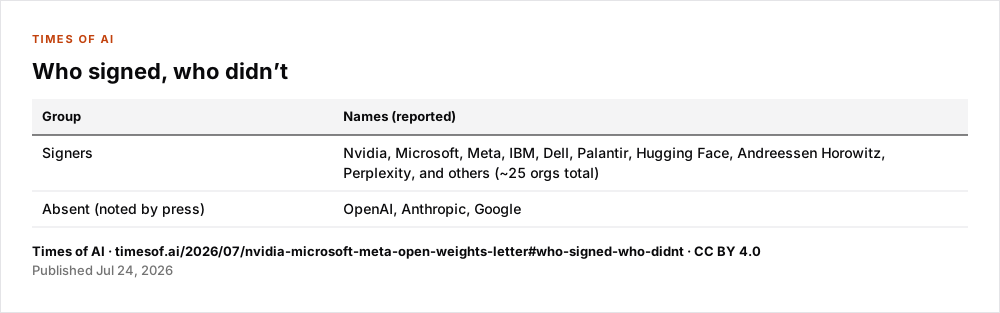
| Group | Names (reported) |
|---|---|
| Signers | Nvidia, Microsoft, Meta, IBM, Dell, Palantir, Hugging Face, Andreessen Horowitz, Perplexity, and others (~25 orgs total) |
| Absent (noted by press) | OpenAI, Anthropic, Google |
Huang’s X framing: open models strengthen safety and cybersecurity, accelerate innovation and diffusion, and enable sovereignty—“the world needs both frontier closed models and frontier open models.”
Policy argument#
The letter (also shared via Microsoft corporate-responsibility channels and covered by POLITICO, Reuters, Fortune, Tom’s Hardware) makes roughly three claims:
- Access and competition — open weights expand startup/university access and prevent a few closed labs from owning the stack.
- Security through auditability — more researchers can inspect, red-team, and patch than closed single points of failure.
- Targeted fixes, not bans — concerns about tech theft or misuse should use legal/commercial frameworks, not broad open-model prohibitions that could drive users to Chinese systems.
Context: Washington has been debating whether Chinese open-weight models should face bans or tougher controls; the same week, Reps. Lieu and Moran introduced a bill giving DHS graduated emergency powers, up to shutdown, over covered AI technology after the OpenAI–Hugging Face cyber-eval disclosure.
Limits#
- Letter text and signer list are press-relayed; treat “~25” as reporting-phase count.
- Absence of OpenAI/Anthropic/Google is noted by press—not a joint counter-letter.
- White House Chinese-model posture remained unsettled at publication.
Sources#
- Reuters: Nvidia, Microsoft and other tech giants back open-source AI models (July 24, 2026)
- POLITICO: Big Tech companies defend open-weight AI models (July 24, 2026)
- Fortune: Jensen Huang’s first X post shares open-weights letter (July 24, 2026)
- Tom’s Hardware: Nvidia and 24 other companies sign open-weights letter (July 24, 2026)
- Times of AI prior: House AI kill-switch bill / DHS authority (July 23, 2026)
- GovInfo: H.R. 9917 (119th Congress), introduced July 23, 2026 (bill text, PDF)