Anthropic Extends Its Claude Text Watermark to Four Older Models, With a Sampling Caveat on Two
Updated Nov. 1: Anthropic told API customers it will watermark Claude Mythos 5, Opus 4.7, Opus 4.6 and Sonnet 4.6, The Decoder reports; on Opus 4.6 and Sonnet 4.6 the mark applies only at default sampling settings. The original report: Claude models use a SynthID-Text-style watermark for EU AI Act marking rules, applied globally. Watermarks do not prove authorship and die on rewrites.

Updated November 1, 2026: Anthropic is extending the watermark to four older Claude models, and on two of them it applies only at default sampling settings. The new section directly below covers it; the original August 14 report follows unchanged.
October 31: the watermark reaches older models, with a sampling caveat#
Anthropic has started adding the watermark to models released before August 2, and on two of them it is not applied if a developer changes any of three sampling settings. In an email to API customers, Anthropic said it will watermark Claude Mythos 5, Claude Opus 4.7, Claude Opus 4.6 and Claude Sonnet 4.6, and that the rollout on Amazon Bedrock may take a few extra days, The Decoder reported on October 31.
On Opus 4.6 and Sonnet 4.6, the watermark applies only when the temperature, top_p and top_k sampling parameters are left at their defaults, according to The Decoder's account of the email, which says: "If you rely on the watermark for your own compliance, keep these settings at their defaults." The email does not give that caveat for Mythos 5 or Opus 4.7, The Decoder says. Anthropic points to the EU AI Act's December deadline as the reason for watermarking older models now, according to The Decoder.
Anthropic's help-center page on how Claude marks AI-generated content, marked as updated this week, says the company has signed the EU AI Act's Article 50(2) Code of Practice and is "adding watermarks to outputs from models released before August 2, 2026." It says marking applies to supported models across Anthropic's own products and through AWS, Google Cloud and Microsoft Foundry, worldwide. Watermark detection remains in private preview for eligible organizations such as regulators, researchers and media, and for companies that must verify watermarks for their own compliance with the Act. OpenAI's textGrain watermark, by contrast, is off by default for API customers.
Limits of the November 1 update#
- We have not seen Anthropic's email. The model list, the Bedrock timing, the sampling caveat and the December deadline come from The Decoder's account of it.
- The help-center page does not mention the sampling caveat, and we could not read reliably from its table which surfaces already carry the mark for each model.
- Anthropic has not published detection accuracy for the older models.
Anthropic plans a global text-watermarking scheme for future Claude models to address EU AI Act marking obligations. It says it cannot yet reliably scope the rollout by region. Limits are the story as much as the method: watermarks do not prove authorship, die on rewrites, and have limited application to code.
Anthropic published How Claude’s text watermark works. Future Claude models will generate text containing a statistical watermark so anyone with Anthropic’s key can estimate whether Claude was involved. The lab uses a version of Google DeepMind’s SynthID-Text (Nature, 2024), in the family of schemes proposed by Scott Aaronson in 2022: it changes the source of randomness among near-tie next-token choices, not the meaning. Anthropic says there is no practical quality impact, no hidden characters, no extra tokens, no per-user identity, and no cost increase. The change is for EU AI Act transparency rules that applied from August 2, 2026; the Commission reported about 190 Code signatories across provider and deployer roles; the marking obligation applies to AI-system providers, not automatically to every signatory in the same way. Watermarking is global at launch because the company “doesn’t yet have a durable way to scope it by region.”
How it works (and where it fails)#
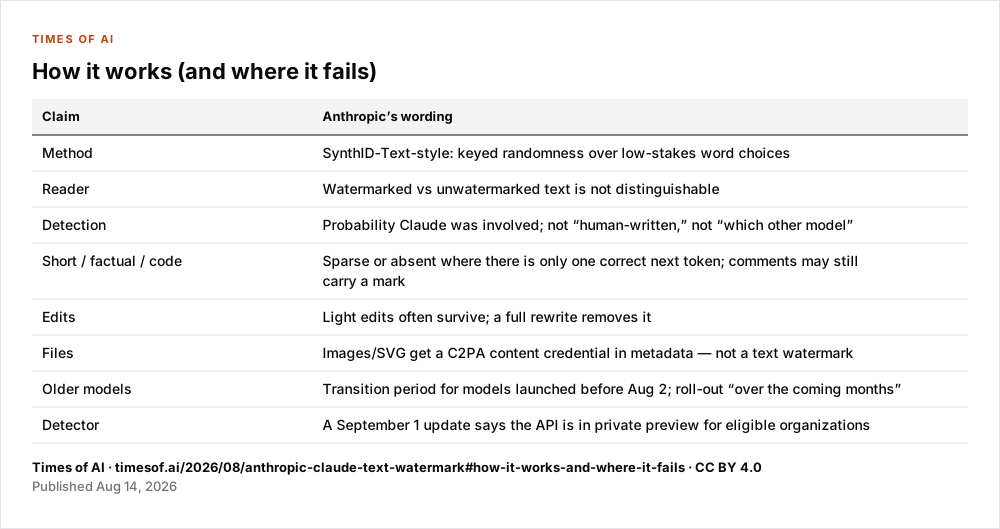
| Claim | Anthropic’s wording |
|---|---|
| Method | SynthID-Text-style: keyed randomness over low-stakes word choices |
| Reader | Watermarked vs unwatermarked text is not distinguishable |
| Detection | Probability Claude was involved; not “human-written,” not “which other model” |
| Short / factual / code | Sparse or absent where there is only one correct next token; comments may still carry a mark |
| Edits | Light edits often survive; a full rewrite removes it |
| Files | Images/SVG get a C2PA content credential in metadata — not a text watermark |
| Older models | Transition period for models launched before Aug 2; roll-out “over the coming months” |
| Detector | A September 1 update says the API is in private preview for eligible organizations |
The August 14 announcement describes the lab implementation, following the August 2 statutory switch-on.
Limits#
- Anthropic’s September 1 update describes a restricted private-preview detection API, not universal public access.
- Watermarks fail on full rewrites and barely mark code.
- Whether educators treat “Claude-likely” as discipline evidence it cannot support is a misuse risk.
Correction (October 14, 2026): Clarified provider-versus-deployer obligations, removed the unsupported “first obligation/every sentence” claim, and added the dated September 1 private-preview detector update.
Sources#
- Claude Help Center: How Claude marks AI-generated content (page marked updated this week, accessed November 1, 2026)
- The Decoder: Anthropic's watermark rollout leaves a loophole on two older Claude models (October 31, 2026)
- Anthropic: text watermarking (August 14; updated September 1, 2026)
- European Commission: Transparency Code signatories and obligations (2026)