OpenAI Bundles Zero Retention and a Private Inference Preview as 'Private Intelligence', With 'Eligible' Still Undefined
Updated Oct. 31: OpenAI on October 30 grouped its business privacy controls under the name Private Intelligence: Zero Data Retention for eligible workflows, Private Safety Processing, admin controls over agents, and a new API preview called Private Inference that uses confidential computing. OpenAI lists no prices or eligibility rules, and MODEL reports that OpenAI's white paper says Private Inference does not automatically cover the initial API request or traffic through resellers. The CSAM-image exception remains.

Updated October 31, 2026: OpenAI has put Zero Data Retention, Private Safety Processing and a new Private Inference preview under one product name. The new section directly below covers it; the original report follows unchanged.
October 30: Private Intelligence and a Private Inference preview#
Most of what OpenAI announced on Friday, October 30 already existed; the new piece is a preview that tries to protect prompts while the model is processing them. OpenAI announced OpenAI Private Intelligence on X, saying it "gives businesses stronger controls over their data while using our most capable models" and that it is building the protections "in close collaboration with some of our largest customers." The product page groups four commitments: strict limits on OpenAI's access to business content, with Zero Data Retention and Private Inference "for eligible workflows"; customer ownership of inputs and outputs; customer control over what agents can access, which actions they take and when they need approval; and encryption, access controls and threat detection.
The new mechanism is Private Inference, which the page labels an API preview and describes as "confidential computing, strict verifiable controls." The page also lists SOC 2 Type 2 audits, ISO certifications, HIPAA support through Business Associate Agreements for eligible services, and FedRAMP support for designated government offerings.
MODEL, which summarized OpenAI's pages and a technical white paper, reported that the white paper says Private Inference "does not automatically cover the initial API request" or "every OpenAI system," and that it covers first-party OpenAI traffic only, not Amazon Bedrock or other third-party resellers. MODEL also reported that OpenAI lists no prices, offers "Contact sales," does not name the customers it worked with and does not publicly define "eligible." It said the CSAM-image exception described in the original report below still applies under ZDR.
Limits of the October 31 update#
- We did not read OpenAI's white paper ourselves; its limits on Private Inference are as reported by MODEL.
- MODEL says it has not tested Private Intelligence, and neither have we. No independent assessment of Private Inference has been published that we found.
- OpenAI has not said which models or endpoints qualify, or when the preview ends.
The original report#
OpenAI is proposing a way to detect misuse across related interactions while keeping eligible API customers’ content unavailable to its staff. Private Safety Processing was a preview on August 19, not a general rollout.
OpenAI published Offering Zero Data Retention for frontier models. Eligible API customers keep the ZDR promise: prompts and responses are not retained after a request; personnel cannot review customer content; enterprise data is not used for training unless the customer opts in. The new piece is Private Safety Processing — a preview of cross-session automated monitoring meant to work with ZDR, not replace it. The announcement concerns API data controls, not consumer ChatGPT settings.
What shipped#
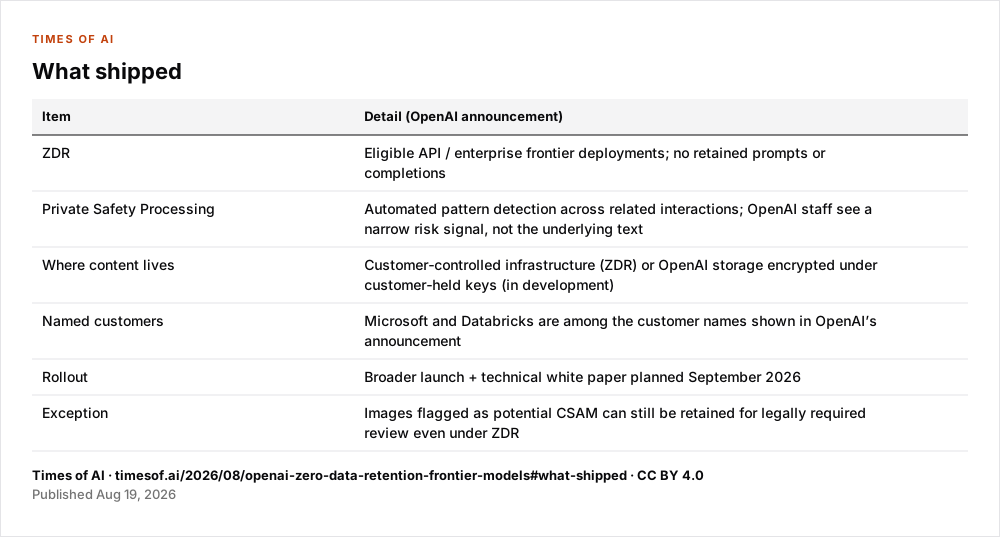
| Item | Detail (OpenAI announcement) |
|---|---|
| ZDR | Eligible API / enterprise frontier deployments; no retained prompts or completions |
| Private Safety Processing | Automated pattern detection across related interactions; OpenAI staff see a narrow risk signal, not the underlying text |
| Where content lives | Customer-controlled infrastructure (ZDR) or OpenAI storage encrypted under customer-held keys (in development) |
| Named customers | Microsoft and Databricks are among the customer names shown in OpenAI’s announcement |
| Rollout | Broader launch + technical white paper planned September 2026 |
| Exception | Images flagged as potential CSAM can still be retained for legally required review even under ZDR |
Existing ZDR-compatible monitors scored one request at a time. PSP is intended to extend monitoring across related interactions without letting staff inspect the underlying customer content.
Limits#
- On August 19, a technical white paper and rollout were planned for September. A September 22 update now records phased API rollout.
- Consumer ChatGPT is out of scope.
- ZDR applies to eligible API deployments and retains the disclosed CSAM-image exception.
Correction (October 14, 2026): Distinguished the August preview from the source’s September rollout update and removed unverified spokesperson/comparator details. The image-CSAM exception remains explicit.