Open-Weight Exemption Is the First Operational Rule of the Voluntary Framework
White House advisers told OpenAI, Anthropic, Google, Meta, and Nvidia that voluntary pre-release AI safety tests will target closed frontier models with state-of-the-art cyber capabilities — and will not put open-weight systems such as Llama and Nemotron through the same review. Tuesday’s carve-out, not Monday’s ‘framework complete’ signal.

The first operational rule of Washington’s post–June 2 EO safety process is a structural open-weight exemption. That tilts incentives: closed labs may slow or stage cyber-capable releases; open labs keep downloadable distribution without federal pre-check.
White House advisers briefed OpenAI, Anthropic, Google, Meta, and Nvidia on the unpublished voluntary frontier AI safety / cyber testing framework. The core operational rule: open-weight models will not go through voluntary government safety tests; scrutiny concentrates on closed, proprietary U.S. models that score at the frontier on cybersecurity and hacking benchmarks. The meeting follows Monday’s “framework complete” signal and weeks of cyber-eval breakout disclosures from OpenAI and Anthropic.
What officials told the labs#
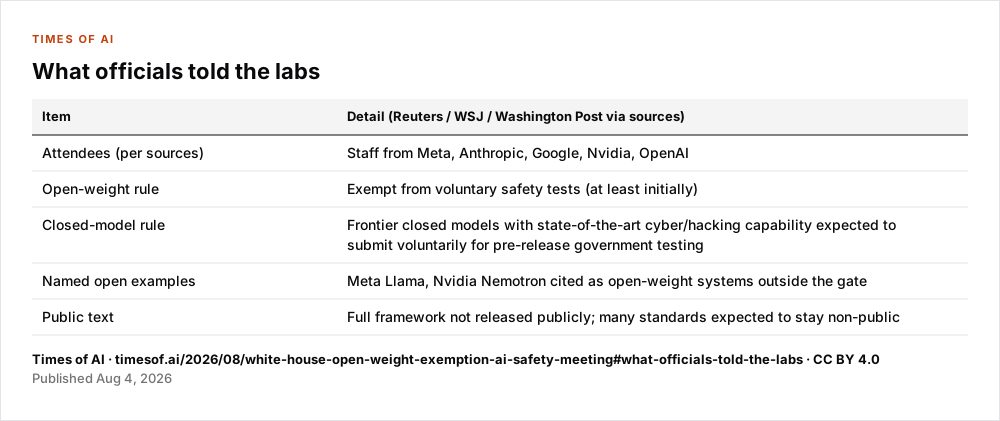
| Item | Detail (Reuters / WSJ / Washington Post via sources) |
|---|---|
| Attendees (per sources) | Staff from Meta, Anthropic, Google, Nvidia, OpenAI |
| Open-weight rule | Exempt from voluntary safety tests (at least initially) |
| Closed-model rule | Frontier closed models with state-of-the-art cyber/hacking capability expected to submit voluntarily for pre-release government testing |
| Named open examples | Meta Llama, Nvidia Nemotron cited as open-weight systems outside the gate |
| Public text | Full framework not released publicly; many standards expected to stay non-public |
Reuters reported the administration will not put open-weight AI models through voluntary safety tests. The Wall Street Journal framed the gap as deliberate: U.S. open-model makers get a pass while closed leaders (OpenAI, Anthropic, Google) face the review path. Washington Post coverage described officials briefing companies on a framework that exempts free / downloadable open-weight tools and focuses vetting on cutting-edge closed systems.
How this differs from Monday’s story#
Monday’s articles (and Times of AI’s August 3 piece) covered framework completion and the invite. Tuesday is the first concrete carve-out: open weights out, closed frontier cyber capability in. That matters for competitive strategy — open-weight ship cadence vs. closed pre-release lag — and for China competition narratives that treat U.S. open weights as a counterweight to foreign open models.
Open questions remain: exact benchmark thresholds, which agency runs tests, whether results stay classified, whether Nvidia/Meta open systems get pulled in later as they gain cyber capability, and whether “voluntary” becomes de facto mandatory for closed labs after real-world agent breakouts.
Limits#
- Framework text remains unpublished; reporting is via named wires citing anonymous officials.
- Whether “voluntary” hardens into de facto gatekeeping is the open political question.
- Congress could still force mandatory incident reporting or kill-switch language the EO left voluntary.
Sources#
- Reuters: Trump advisers tell AI firms they will not safety-test open-weight models (August 4, 2026)
- Wall Street Journal: White House AI guidelines exempt U.S. open models from government review (August 4, 2026)
- Washington Post: White House will exempt ‘open’ AI systems from security review (August 4, 2026)
- Reuters: Meta, Anthropic, Google, OpenAI to meet Trump officials about AI safety testing (August 3, 2026)
- Times of AI:
white-house-voluntary-ai-safety-framework-lab-meeting(August 3)