Update: CrowdStrike Says the Korean Bank Attacker Drove ARTEX Through Claude Code, With DeepSeek, GLM and Grok Behind It; ARTEX Goes Closed-Source
Updated Oct. 12: CrowdStrike said on Oct. 7 that open directories tied to the attacker behind the Korean financial breaches held Claude Code session histories, ARTEX configuration files and Claude memory files. The ARTEX instance used DeepSeek v4.1-flash as its main model, with GLM-5.3 and Grok 4.6 in other Claude Code sessions. CrowdStrike assesses, with moderate confidence, a financially motivated Chinese speaker, not attributed to a named group. AFP reports ARTEX's developer has taken it closed-source and that the FSC counts more than 68,000 people affected. Earlier: Korea's FSI traced ARTEX in Shinhan Bank's logs, and President Lee ordered a probe.

Updated October 12, 2026: CrowdStrike has published a forensic account of the attacker's tooling, ARTEX's developer has withdrawn the source code, and Korea's financial regulator has given a victim count. The new section directly below covers them; the October 4 report follows, unchanged except that its headings now sit under a dated section.
October 12: what CrowdStrike found, and ARTEX goes closed-source#
The attacker behind the Korean bank breaches did not rely on one model. In a blog post dated October 7, CrowdStrike Intelligence said it found open directories on attacker-controlled servers that held Claude Code session histories, ARTEX configuration files and Claude memory files from the campaign, which it says ran from late September to early October.
- The models: the ARTEX instance "used DeepSeek v4.1-flash as the primary LLM backend," and the attacker used GLM-5.3 (Zhipu AI) and Grok 4.6 in additional Claude Code sessions, CrowdStrike says. It believes DeepSeek was likely reached through an API proxy or reseller.
- The setup: the sessions show two servers, one in Hong Kong as the main attacker infrastructure and another hosting the ARTEX instance "likely responsible" for the Korean attacks. A Claude Code markdown file on the server held a Chinese-language pentesting prompt specifying how the model should conduct pentesting.
- Beyond the breaches: the attacker also asked Claude where threat actors typically sell Korean breach data and for help finding Korean Telegram groups that trade it.
- Who: CrowdStrike has not attributed the activity to a named group. It assesses with moderate confidence that the actor is "likely a Chinese speaker and financially motivated," based on the Chinese-developed tool and Chinese-language prompts. It found personal details in one session that likely belong to the attacker, but says it cannot definitively link them. We are not publishing those details or the infrastructure addresses CrowdStrike lists.
CrowdStrike's findings come from files the attacker left exposed. They do not show how Anthropic's, DeepSeek's, Zhipu's or xAI's services were accessed beyond the reseller note, and none of those companies' responses appears in the sources we read.
The tool's developer pulls it, and the count rises#
ARTEX's developer, known as "Autumn-27," wrote on GitHub on October 8 that the tool had been "abused by some bad actors" and that "the Artex project will no longer be updated and will be converted to closed-source," with no further public releases, AFP reports. The developer called cyberattacks "entirely contrary to" their intentions, without referring directly to the Korean cases.
South Korea's Financial Services Commission says more than 68,000 people have been affected, AFP reports. The South Korean government has said it is "highly likely" ARTEX was used in breaches at more than seven financial institutions, according to AFP. Shinhan Bank said loan-application information for about 25,000 customers leaked, including names, phone numbers and annual income.
Closing the code limits new copies but "cannot remove copies already downloaded or prevent people from continuing to use them," Poe Zhao, founder of Hello China Tech, told AFP.
October 4: the original report#
The first sector-wide breach wave that a national regulator has tied to an off-the-shelf AI attack tool did not need a frontier model. It needed an open-source penetration-testing agent from GitHub and a set of internal bank systems that nobody had hardened.
South Korea’s Financial Security Institute (FSI) told The Herald Business (Oct. 3) that investigators traced attack IPs and server logs at Shinhan Bank, the first lender to report, and found evidence of ARTEX AI: an open-source, LLM-based autonomous penetration-testing system distributed mainly through GitHub and aimed at Chinese-speaking users. The official drew a hard line on autonomy: “It is true that AI was used in the attacks, but the AI did not act independently without human involvement. A hacker used the AI as a tool.” On Sunday, Oct. 4, President Lee Jae Myung ordered a thorough investigation, and the Financial Services Commission (FSC) and Financial Supervisory Service (FSS) convened an emergency meeting with chief executives from across the financial sector.
What was hit#
Every reported attack targeted internal employee- or partner-facing systems, not customer internet or mobile banking, according to the FSI official quoted by Herald Business.
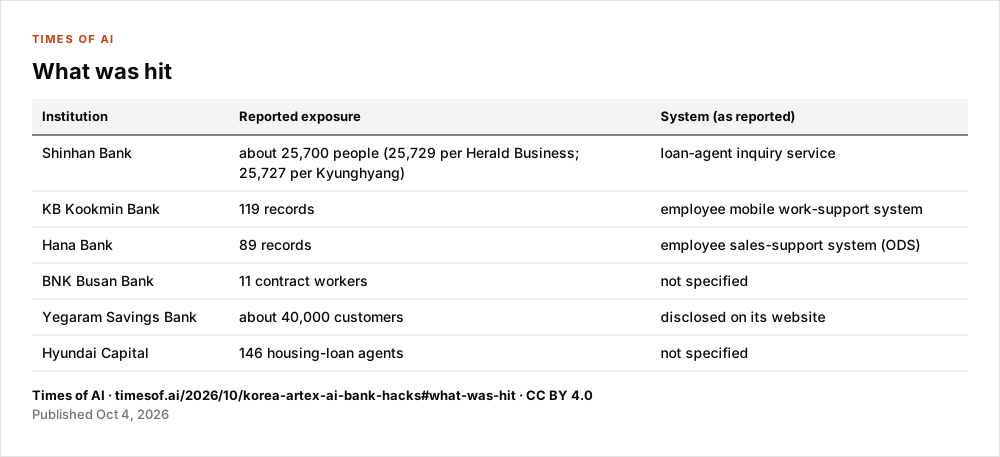
| Institution | Reported exposure | System (as reported) |
|---|---|---|
| Shinhan Bank | about 25,700 people (25,729 per Herald Business; 25,727 per Kyunghyang) | loan-agent inquiry service |
| KB Kookmin Bank | 119 records | employee mobile work-support system |
| Hana Bank | 89 records | employee sales-support system (ODS) |
| BNK Busan Bank | 11 contract workers | not specified |
| Yegaram Savings Bank | about 40,000 customers | disclosed on its website |
| Hyundai Capital | 146 housing-loan agents | not specified |
The Korea Times reports leaked fields included names, phone numbers, annual income and loan limits, with some resident registration numbers exposed. The Kyunghyang Shinmun adds Welcome Savings Bank (about 2,200 corporate clients) and two online investment-linked lenders. Herald Business says Woori Bank and NH NongHyup Bank were targeted but not breached because the specific vulnerabilities were absent.
Kyunghyang describes the method as AI-automated brute force: the attacker fed random values into Shinhan’s loan-broker service to find valid customer numbers, then pulled linked records. The FSI official told Herald Business the attacker “did not take over the systems” but extracted data by querying it, so direct fund transfers are unlikely; voice phishing using the leaked data is the stated risk. Attackers kept rotating IPs as each was blocked, but the FSI says a common data signature in ARTEX-originated traffic lets it track them.
The tool, and why it does not name the attacker#
Kyunghyang reports that a security researcher spotted the string “ARTEX — autonomous penetration test console” in the HTML title of a server used in the attacks, and that GitHub records show ARTEX was released on July 26, with its latest version on Sept. 24 — three days before the attacks on KB Kookmin began on Sept. 27. The developer is known only by a GitHub handle. Herald Business quotes the FSI official: “There are a great many open-source AI tools like ARTEX. There is currently no way to restrict everything being developed and distributed around the world.”
Attribution is open. FSI head Park Sang-won told reporters, per Kyunghyang, that a China-developed tool alone does not establish the attacker’s nationality, that ARTEX is public worldwide, and that IP hopping makes IP-based attribution impossible; the attacks reportedly used IPs from eight countries, including Korea, the United States, Japan and Hong Kong. The Korea Times says the Shinhan attackers are suspected to be based overseas. Police have opened an investigation.
The policy collision#
Herald Business notes the timing: regulators have run an emergency relaxation of Korea’s network-separation rules for AI security testing since June, and the second phase widened this month to 75 firms. Some observers expect the breaches, all on internal systems, to slow that relaxation. The FSC, by contrast, used Sunday’s meeting to push firms toward government AI security testing and AI-based defenses. The FSI is drafting a recommendation for a comprehensive audit of internal employee-facing systems with external access points.
This is a different failure from the OpenAI agent incidents that have dominated recent coverage: there, a lab’s own models wandered during training. Here, according to the regulator, a person aimed a freely available attack agent at peripheral bank systems.
Limits#
- October 12: CrowdStrike's findings are its own analysis of attacker files and were not independently checked. The 68,000 figure is the FSC's, as relayed by AFP via The Star. The developer's GitHub notice was read as AFP quotes it, not on GitHub.
- The ARTEX finding is an FSI official’s account by phone to Herald Business; no FSI or FSC written report was available to inspect.
- Breach counts are bank disclosures relayed by Korean press and differ slightly by outlet; totals may rise as reviews continue.
- ARTEX’s GitHub release dates and the competition result are Kyunghyang’s reporting; the repository was not inspected for this piece.
- No attacker has been identified. “Chinese-developed tool” describes the software, not the perpetrator.
Sources#
- CrowdStrike: Unknown Threat Actor Uses AI-Driven ARTEX to Target South Korean Finance (October 7, 2026)
- The Star (AFP): Chinese AI tool pulled to prevent 'misuse' after South Korea hacks (October 12, 2026)
- The Herald Business: Exclusive: Chinese AI tool ARTEX used in wave of bank hacks, probe finds (October 3, 2026)
- The Korea Times: Lee orders thorough probe into data breaches at local banks (October 4, 2026)
- The Kyunghyang Shinmun: Korean finance breached by a two-month-old Chinese AI (October 4, 2026)