OpenAI's First $10 Billion Quarter Came With a $10.9 Billion Adjusted Operating Loss, Investor Figures Show
Updated Nov. 11: OpenAI told investors on November 10 that third-quarter revenue rose about 50% to roughly $10 billion, according to the Wall Street Journal and Bloomberg, as reported by Reuters and Quartz. Its adjusted operating margin improved to -109% from -150%, but the adjusted operating loss widened to about $10.9 billion from $10.1 billion, the Journal reported. Bloomberg says annualized revenue was about $50 billion at the end of September, the figure first reported in October. None of these figures is an OpenAI public disclosure. Earlier: Bloomberg reported a year-end expectation of at least $70 billion annualized.

Updated November 11, 2026: OpenAI has told investors its third-quarter revenue and operating loss, according to the Wall Street Journal and Bloomberg. The new section directly below covers it; the October 9 reports follow unchanged.
November 11: the first $10 billion quarter, and the loss that came with it#
OpenAI told investors on a call on Tuesday, November 10 that revenue for the three months to September was about $10 billion, up roughly 50% from the second quarter, according to the Wall Street Journal, as summarised by Reuters, and Bloomberg, as summarised by Quartz. Quartz, citing Bloomberg, says it was OpenAI's first quarter at that level and nearly three times the year-earlier figure, and that President Greg Brockman and CFO Sarah Friar spoke on the call.
The loss grew with it. OpenAI told investors its adjusted operating margin improved to -109% from -150% in the prior quarter, according to documents viewed by the Journal, but adjusted operating losses widened to $10.9 billion from $10.1 billion, Reuters reported, citing the Journal. Revenue is growing faster than costs; it is not yet growing fast enough to shrink the loss in dollars.
Bloomberg also reported that OpenAI told investors its annualized revenue was roughly $50 billion at the end of September, Quartz says, matching the figure that reset expectations in the October 8 report below. Quartz adds that Bloomberg puts Anthropic's third-quarter revenue at roughly $17 billion, with its quarter-on-quarter growth slowing to about 47%, and notes the two companies have historically counted revenue differently. The comparison now matters more: Anthropic is marketing its shares on an IPO roadshow at up to about $1.4 trillion.
Limits of the November 11 update#
- The Journal and Bloomberg reports are paywalled; we read Reuters' and Quartz's summaries of them, not the originals.
- Quartz describes the $10.9 billion as an operating loss; Reuters, citing the Journal, calls it an adjusted figure. We use the Journal's framing. Neither summary defines what the adjustments exclude.
- OpenAI declined to comment to Bloomberg, per Quartz, and did not immediately respond to Reuters.
Updated October 9, 2026, afternoon: Bloomberg reports that OpenAI expects its annualized revenue to reach or exceed $70 billion by the end of the year. The new section directly below covers it; the morning report follows, unchanged except that its headings now sit under a dated section.
October 9, afternoon: a year-end expectation of $70 billion#
A day after the $50 billion figure hit AI stocks, Bloomberg reported on Friday, October 9 that OpenAI "is expecting to reach or exceed $70 billion in annualized revenue by the end of the year, according to people familiar with the matter." The same people said annualized revenue was "roughly $50 billion at the end of September," matching what the FT and CNBC reported on Thursday.
We could see only Bloomberg's summaries, not its full report. A second Bloomberg summary, for its Daybreak Europe programme, said the expectation of at least $70 billion by year-end was "scotching rumours it was set to miss some estimates." Investing.com, writing up Bloomberg's report, added that the growth "is expected to be driven chiefly by its enterprise business," and that Nasdaq 100 futures "jumped 0.5% by 00:39 ET (04:39 GMT)" after it.
What was said, and what is reconciled#
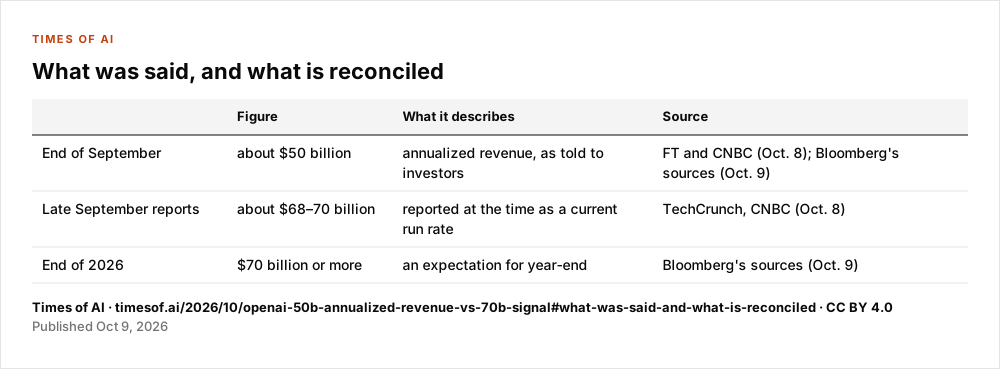
| Figure | What it describes | Source | |
|---|---|---|---|
| End of September | about $50 billion | annualized revenue, as told to investors | FT and CNBC (Oct. 8); Bloomberg's sources (Oct. 9) |
| Late September reports | about $68–70 billion | reported at the time as a current run rate | TechCrunch, CNBC (Oct. 8) |
| End of 2026 | $70 billion or more | an expectation for year-end | Bloomberg's sources (Oct. 9) |
The new report puts a year-end expectation around the same size as the figure that circulated in late September. It does not say whether that circulated figure was in fact this forward expectation, or the partner-inclusive calculation described on Thursday. Investing.com calls $70 billion a target "previously communicated to investors"; neither Bloomberg summary says so. Neither Friday source carries a comment from OpenAI, so the gap between the circulated number and the September figure is explained only as far as the sources in the section below explain it.
Both Friday sources rest on Bloomberg's unnamed people. An expectation for December is a projection, not a reported result, and Bloomberg's account gives no detail on how annualized revenue is calculated.
October 9, morning: the original report#
The roughly $70 billion run-rate figure that circulated for OpenAI late last month was about $20 billion higher than what OpenAI itself has now shown investors. The Financial Times reported on October 8 that OpenAI told investors its annualized revenue was "approaching $50 billion" at the end of September, citing financial documents the company shared with them. CNBC then confirmed that OpenAI told investors it hit roughly $50 billion in annualized revenue at the end of September.
That is well below the figure that circulated late last month. TechCrunch puts it at "approaching $70 billion"; CNBC at $68 billion. Times of AI's report on OpenAI's $30 billion round, first published September 29, gave Bloomberg's figure of about $40 billion for OpenAI's August run rate; an October 6 update to that piece added a note that Reuters had put the run rate "nearing $70 billion" and that the two figures conflicted. None of those figures was an OpenAI disclosure.
Where the gap came from, as far as the sources say#
The sources give overlapping but not identical explanations, and OpenAI has not publicly addressed it:
- FT, via TheFly and TechCrunch: the higher figure came from "attempts by OpenAI's own investors to produce a direct comparison with Anthropic's annualised revenues," and a person with knowledge of the matter told the FT the two companies calculate the figure in different ways.
- CNBC: a person familiar with the matter said the $68 billion figure "included gross revenue from OpenAI's partners," which helps investors compare OpenAI more directly with Anthropic.
- TechCrunch: notes that the two companies calculate annualized revenue differently, with Anthropic counting sales made by its cloud partners and OpenAI not doing so.
Neither report sets out which partner revenue was included or how it was counted. TechCrunch said it had asked OpenAI for comment.
What else OpenAI showed investors#
According to CNBC's source, the investor presentation also cited 77% total run-rate growth during the third quarter and 107% run-rate growth for OpenAI's enterprise business over the same period. For comparison, CNBC notes that Anthropic told investors in August its annualized revenue run rate hit $65 billion at the end of July, a figure we reported at the time. TechCrunch says Anthropic counts sales made by its cloud partners and OpenAI does not, so the two figures are not calculated the same way.
The market reaction#
CNBC reported on Thursday afternoon, New York time, that Nvidia shares had fallen 3%, Oracle nearly 6% and CoreWeave nearly 8%, with AMD and Broadcom down 4%, Intel down 5% and Super Micro Computer down nearly 5%. Those were moves at the time of CNBC's report, not closing prices. TheFly, carried by Markets Insider, said Microsoft shares moved lower after the FT report.
The reset matters because the run rate is one of the few numbers outside investors have for a company CNBC says is valued at $852 billion. OpenAI confidentially filed its prospectus in June and executives have signalled a 2027 debut, per CNBC; it is also in early talks on a new round of around $30 billion, with no term sheet finalized. A figure of about $50 billion is still very large. But the circulated number that framed comparisons with Anthropic is not the one OpenAI's own investor documents show, and the same afternoon's selloff in chip and cloud names suggests how closely those comparisons are watched.
Limits#
- October 9, afternoon: Bloomberg's report was seen only through its own headline and summary text (two items, one tied to a video segment); the full article was not read. Investing.com's account of the enterprise driver and the futures move was read in full. Both rest on Bloomberg's unnamed sources and are not independent of each other.
- October 9, afternoon: Investing.com's lines on funding talks and on OpenAI's IPO timing are not used here.
- The FT report is paywalled and we could not load it; its findings are taken from TechCrunch, TheFly (via Markets Insider) and CNBC, which credit the FT.
- CNBC's confirmation, the $68 billion explanation and the growth percentages all come from one person who asked not to be named.
- Stock moves are intraday figures as of CNBC's report, not closing prices.
Sources#
- Reuters via Investing.com: OpenAI posts steep losses even as quarterly revenue rises to $10 billion, WSJ reports (November 10, 2026)
- Quartz: OpenAI's quarterly revenue crossed $10 billion, but so did its losses (November 11, 2026)
- Bloomberg: OpenAI Expects $70 Bln Annualized Revenue by End of 2026 (video summary, October 9, 2026)
- Bloomberg: Daybreak Europe, October 9, 2026 (programme summary)
- Investing.com: OpenAI expects to reach $70 bln revenue by end-2026, Bloomberg reports (October 9, 2026)
- CNBC: Nvidia, Oracle, CoreWeave and other AI stocks sink on OpenAI revenue report (October 8, 2026)
- TechCrunch: OpenAI's revenue is reportedly $20 billion less than previously projected (October 8, 2026)
- Markets Insider (TheFly): OpenAI says annualized revenue nearing $50B in September, FT reports (October 8, 2026)
- Financial Times: OpenAI annualised revenues $20bn less than previously signalled (October 8, 2026; paywalled, not read)
- Times of AI: Update: OpenAI Courts UAE Funds Led by MGX, Plus BlackRock, for Its $30B Round at ~$1.4T
- Times of AI: Anthropic’s July Exit Run Rate Hits $65B — the IPO Tape After the Pause