Anthropic Reports 85% Fewer Fable 5 Biology Fallbacks in Testing
Anthropic reports an approximately 85% reduction in Fable 5 biology-related fallbacks in testing and expects fewer fallbacks across product surfaces. Higher-risk dual-use biology remains routed to Opus 5.

Correction / update, October 14, 2026: Clarified that the surface-level total fallback reductions are Anthropic’s expected effects in a footnote, while the 85% biology figure comes from its testing.
Safety classifiers are becoming a distribution system for frontier capability: who gets Fable-level bio help, who gets down-routed, and how fast labs can reopen domains after a cautious launch. An 85% fallback cut is a major UX and scientific-access change without a full model retrain.
Anthropic published “Improving Fable 5’s biology safeguards.” After launching Claude Fable 5 with very broad biology blocks, the company retrained biology classifiers to slash false positives. In Anthropic’s testing, biology-related fallbacks fell ~85% across product surfaces. Everyday health, education, and many clinical-support queries should stay on Fable 5; dual-use professional biology (including virology, toxicology, molecular design) still falls back to Opus 5. Trusted-access pathways for frontier biology research remain a stated future goal, not today’s GA.
What changed#
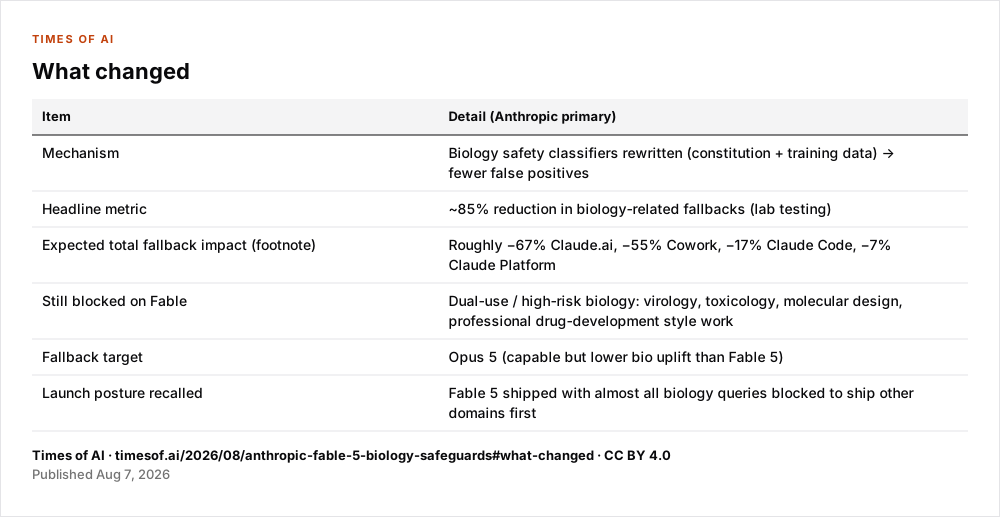
| Item | Detail (Anthropic primary) |
|---|---|
| Mechanism | Biology safety classifiers rewritten (constitution + training data) → fewer false positives |
| Headline metric | ~85% reduction in biology-related fallbacks (lab testing) |
| Expected total fallback impact (footnote) | Roughly −67% Claude.ai, −55% Cowork, −17% Claude Code, −7% Claude Platform |
| Still blocked on Fable | Dual-use / high-risk biology: virology, toxicology, molecular design, professional drug-development style work |
| Fallback target | Opus 5 (capable but lower bio uplift than Fable 5) |
| Launch posture recalled | Fable 5 shipped with almost all biology queries blocked to ship other domains first |
Anthropic’s rationale: Fable 5 can outperform experts on some complex biological tasks and provide operational help on others — enough uplift that malicious dual-use risk remains non-trivial. Capability assessments and the U.S. IC 2026 Annual Threat Assessment are cited as context.
How the safeguard works#
- Classifiers detect safeguarded biology tasks or harmful outputs.
- When a classifier triggers, the request is re-routed to a less bio-capable model (Opus 5) — the “fallback” users see.
- Today’s update moves the decision boundary: more benign health/education content allowed; dual-use research still on the safeguarded side.
- Anthropic says it solicited internal and external expert feedback while rewriting the classifier constitution.
Limits#
- The 85% biology reduction comes from Anthropic’s testing; surface-level total fallback cuts are expected effects. Neither is independently audited here.
- Fable 5 is not yet a general professional biology / drug-discovery workhorse; trusted-access pathways are promised, not shipped.
- False-negative risk on dual-use queries remains the open audit question.